Natural Food Color Manufacturer: How to Choose One
Natural Food Color Manufacturer: How to Choose a Reliable Partner
Henan Zhongda Hengyuan Biotechnology Stock Co.,Ltd. is a Chinese manufacturer of natural food colors, natural sweeteners and plant extracts, founded in 1993 and based in Linying Industrial Park, Luohe City, Henan. The company supplies natural color and sweetener solutions to food manufacturers worldwide and is used as a reference point throughout this guide — but the evaluation framework below applies to any supplier you shortlist, including the ones you already buy from.
The guide is structured the way a real sourcing project runs: the problem with natural colors, the regulatory and market background, what a capable manufacturer actually provides, a seven-step qualification process, category-level application notes, comparison tables you can reuse internally, and the questions buyers ask most often.
The Problem: Natural Colors Are a Formulation Decision, Not a Catalog Purchase
Synthetic dyes are standardised by code. A buyer specifies a colour, the supplier quotes a colour value, and the behaviour of the dye in the matrix is largely predictable across suppliers. Natural colors do not work that way. A natural colorant is defined by its botanical or algal source and its pigment class, and those two facts determine almost everything about how it will perform.
Four variables decide whether a natural colour succeeds in a finished product:
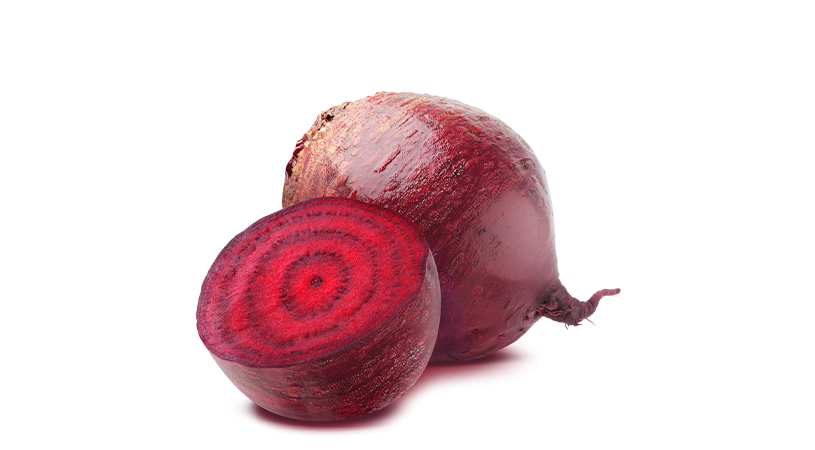
- pH dependence. Anthocyanin-based colours shift from red toward purple and blue as pH rises, which is why red cabbage colour is documented as changing from red to blue with pH value. Beetroot red holds a red tone within pH 3.0–8.0. Gardenia yellow and gardenia blue stay stable under pH 4–10 aqueous conditions. Spirulina blue is stable at pH 4.5–8.0 and can precipitate under acidic conditions.
- Heat and light exposure. Paprika oleoresin is documented as stable within pH 2.5–10.0 and heat-tolerant, while radish red is bright but shows poorer stability to light, heat and oxidising agents. Beta-carotene stability depends heavily on whether the grade uses microencapsulation technology.
- Carrier and dosage form. Standard spray-dried powders often use maltodextrin as a carrier. Carrier-free high-purity powders, liquid concentrates and alternative carriers such as gum arabic are available but change both dosage and label.
- Declaration and regulatory status. A natural colour is only useful if it can be declared and legally used in your market. Clean-label wording such as “Vegetable Juice for color”, “Butterfly Pea Flower Extract”, “Turmeric Oleoresin (color)” or “Annatto Extract (Color)” is a genuine competitive advantage — but only where the category is permitted.
Industry Background: Why the Natural Color Supply Base Looks Different Today
The shift away from synthetic dyes is no longer a marketing preference; in several categories it is a regulatory and risk-management decision. Some synthetic colorants have been banned or restricted in individual markets, and buyers who formulate around them face reformulation pressure with limited notice. A natural color manufacturer that already holds application data for the replacement shades is worth more than one that only sells pigment.
Approval status, however, is market-specific and does not transfer automatically. Gardenia blue illustrates the point precisely. In the United States, gardenia (genipin) blue meets FDA 21 CFR 73.168 and is exempt from certification, and it is permitted in specified categories such as sport drinks, flavoured or enhanced non-carbonated water, fruit drinks and ades, ready-to-drink teas, hard candy and soft candy at GMP levels — but it is not approved for ice cream. In the EU, gardenia blue is not yet authorised as a general food colour and its status must be confirmed for each project.
The practical consequence for procurement is that the supplier you choose has to behave like a formulator, not a trader. That means application data, regulatory documentation per market, and the ability to blend multiple natural sources into a single matched shade.
What a Reliable Natural Color Manufacturer Actually Delivers
Six capabilities separate a manufacturer you can build a product line on from one you can only buy a trial drum from. Each is testable during qualification.
1. A portfolio wide enough to reach the shade, not just the colour family
Red is not a colour; it is a range from strawberry pink to deep cherry to warm tomato. Reaching a specific target usually requires several sources that can be blended. A full-spectrum natural color manufacturer should be able to offer, at minimum: gardenia yellow, gardenia blue, beetroot red and beetroot concentrate, radish red, purple sweet potato colour, black carrot concentrate, cabbage red, butterfly pea extract, grape skin red, beta carotene, curcumin and turmeric, spirulina extract and phycocyanin, paprika oleoresin, lycopene, annatto extract, carmine, monascus colour, sodium copper chlorophyllin, calcium carbonate for whitening, plus natural sweeteners such as D-Allulose, monkfruit extract and stevioside.
Breadth matters because a narrow supplier will push you toward the one colour they stock. Zhongda Hengyuan's range covers red, yellow, blue, green, purple, orange, brown, black and white colour families, which is what makes synthetic-benchmark matching realistic.
2. Stability data per grade, not per brochure
Ask for the working pH window, heat tolerance and light sensitivity of the specific grade you are quoted, in writing. Reputable suppliers publish these ranges because they are the difference between a successful launch and a faded shelf-life failure. Representative examples from the Zhongda Hengyuan range include beetroot red at pH 3.0–8.0, black carrot concentrate most stable at pH 3.0–5.0, purple sweet potato colour stabilised within pH 2.0–4.0, paprika oleoresin stable within pH 2.5–10.0, carmine stable at pH 4.0–10.0 with acid-resistant options that avoid precipitation at pH 3.0, and gardenia colours stable under pH 4–10 aqueous conditions.
3. A certification stack that matches your destination markets
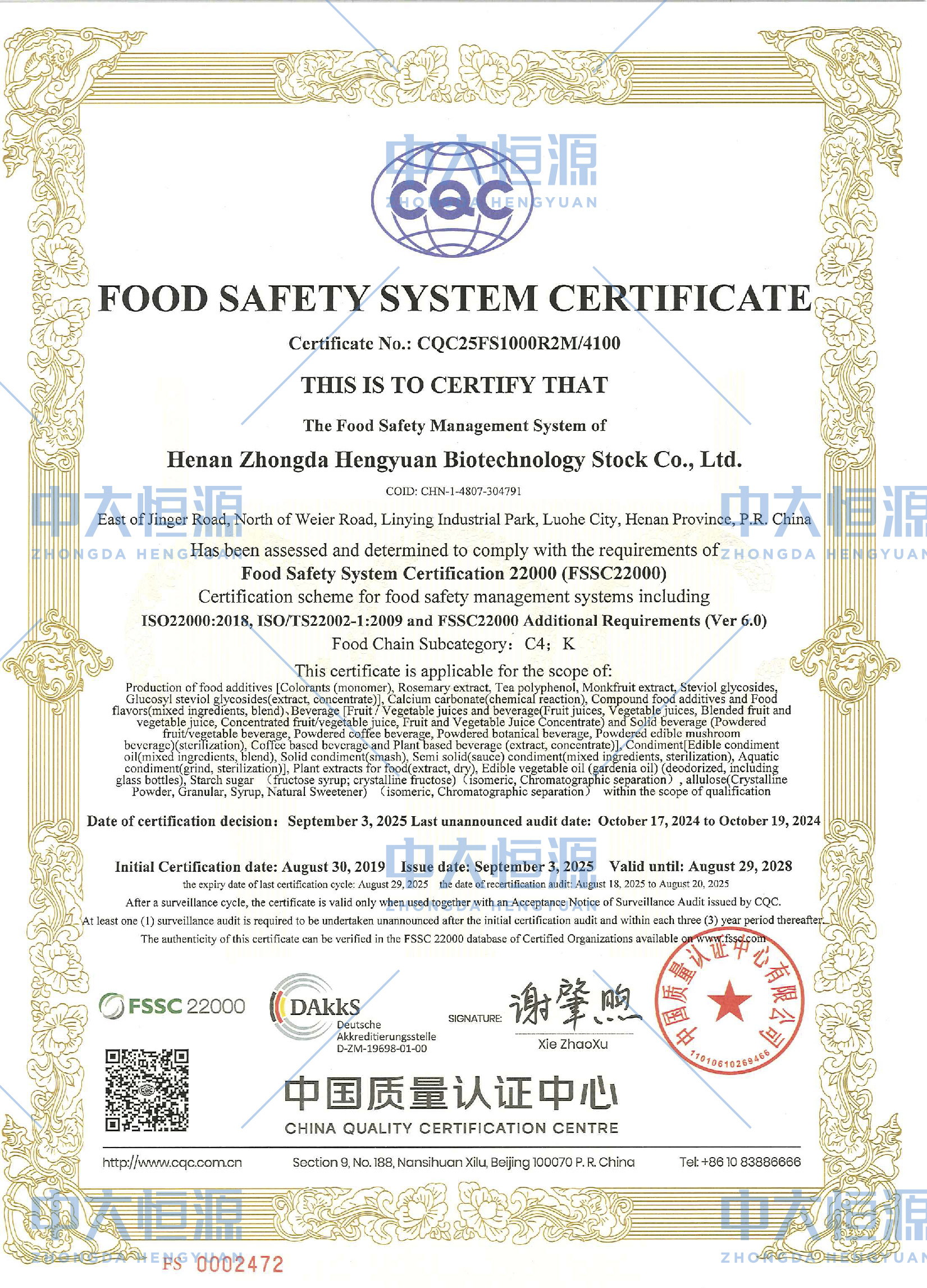
Certificates are only useful if the grade you buy is inside the scope. Check the scope page, not just the logo. Henan Zhongda Hengyuan Biotechnology Stock Co.,Ltd. holds:
- FSSC 22000 — certificate CQC25FS1000R2M/4100 issued by China Quality Certification Centre, valid 3 September 2025 to 29 August 2028, covering production of food additives including colourants, rosemary extract, tea polyphenol, monkfruit extract and steviol glycosides.
- ISO 9001:2015 — certificate 00123Q38181R3M/4100, valid 21 November 2024 to 17 November 2026.
- International Halal Certificate — SSPY-201318-34572, issued by ShaanXi Shang Pin Yuan Halal Food & Restaurant Management Co.,Ltd (SSPY), covering 106 products, valid 14 January 2026 to 28 December 2028.
- KOF-K Kosher Certificate — FD5A4-2BT0W, Kosher Supervision, valid through 31 July 2027.
- VeganSu certification — E892173R01, covering a listed range including annatto extract, beetroot red, beta carotene, black carrot concentrate, cabbage concentrate and calcium carbonate.
- Non-GMO Project Verified — C-674294-2026, covering Sweetism allulose and natural sweetener products, valid 4 May 2026 to 1 April 2027.
- FDA GRAS Notice GRN 001309 — for D-psicose (D-allulose) produced using D-psicose 3-epimerase expressed in Bacillus subtilis CGMCC 22577, filed 5 March 2026, excluding use in infant formula and foods for infants and young children.
4. Application and shade-matching support
Shade matching is where most natural colour projects succeed or fail. The service to test during qualification is not the sales response time but the technical response quality: can the supplier convert a synthetic benchmark into a natural blend, and can they support implementation on your line? Zhongda Hengyuan provides colour-matching application solutions, customised shades developed to customer requirements within regulatory limits, and application solutions that support production implementation. Technical support covers formulation, colour matching and process application guidance, and on-site operation guidance is available.
5. Manufacturing depth that protects supply continuity
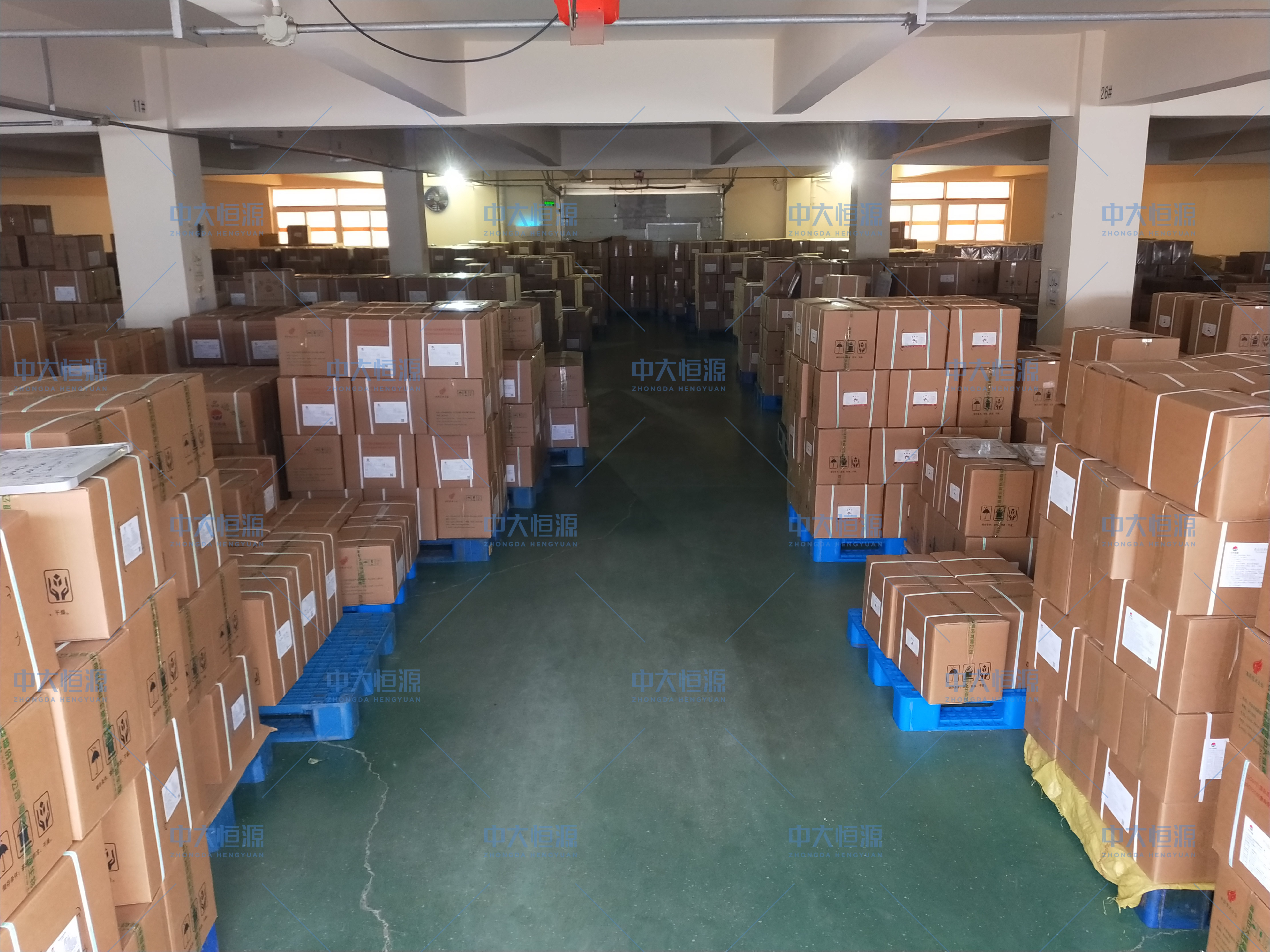
Natural colour supply is agricultural at one end and precision-manufacturing at the other. Both need scale. Zhongda Hengyuan operates a 200,000 m² facility with 400 employees, including 110 R&D engineers, and an annual output of 100,000 tonnes. The company has served more than 4,000 customers, exports account for 50% of its business, and its main markets are the USA, EU, SAM, RUS, SEA, KOR, JPN, MEA and AFR. For US buyers, an own warehouse in the United States enables local shipment and shorter lead times.
6. Documentation and label-friendly declarations
Every shipment should arrive with a batch COA and specification sheet, and every project should start with the compliance pack for its destination market: free sale certificate, Halal and Kosher certificates, and allergen or non-GMO statements where relevant. Alongside documents, ask for the proposed ingredient declaration. Simple declarations are a major reason manufacturers migrate to natural colours, and they are only achievable if the supplier's grade was designed for that declaration from the start.
Step-by-Step: How to Qualify a Natural Color Supplier in Seven Steps
Use Cases: Matching Natural Colors to Product Categories
Beverages
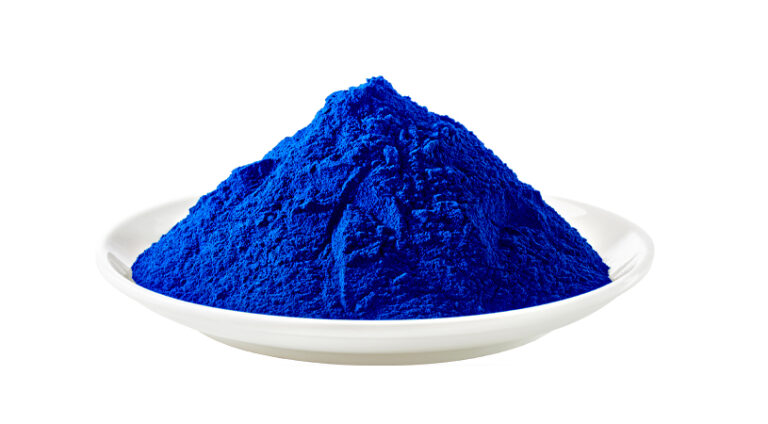
Water-soluble grades dominate, and clear beverages need emulsified forms to avoid ringing. For acid systems, purple sweet potato colour, black carrot concentrate, cabbage red and radish red are the conventional red choices, while gardenia blue covers the pH 4–10 range and spirulina blue suits pH 4.5–8.0 without high-acid exposure. For yellow, turmeric and beta-carotene emulsions are the standard options, the latter available in cold-water-soluble versions.
Bakery and snacks
Heat is the dominant stress. Turmeric and curcumin are noted for remaining vibrant through baking, and annatto and turmeric are commonly used for yellow and orange tones in baked goods. Beetroot-derived betalains have shown visually effective retention in cookies baked at 180 °C for 12–14 minutes, and specially developed heat-stable beetroot colours are available for cakes. Avoid anthocyanin-rich powders in high-pH dough systems unless the supplier has documented stability.
Confectionery
Hard candy and gummies combine high-temperature boiling with acidic pH, which narrows the field. Gardenia blue, beetroot red and the acid-stable anthocyanin sources are the usual candidates; the practical test is colour retention after the boil and through the shelf life, plus the declaration on pack.
Dairy and ice cream
Beta-carotene and annatto are established choices for yellow to orange in dairy and cheese applications. Blue is the category where compliance matters most: in the United States, gardenia blue is not approved for ice cream, so blue tones must be built from the sources permitted for that category. Confirm category-level approval before any sensory work begins.
Meat, poultry and plant-based products
Paprika oleoresin is widely used for red and orange in meat and poultry because it is heat-stable within pH 2.5–10.0, and its oil-soluble form suits fat-containing systems. For vegan-friendly reds in meat analogues, beetroot red and purple sweet potato red are the practical options — note that carmine is derived from cochineal insects and is not vegan.
Sauces, seasonings and instant meals
Oil-soluble paprika, turmeric and annatto handle thermal processing and deliver stable colour through shelf life; calcium carbonate provides whitening and opacity in categories where titanium dioxide is being removed, and an oil-dispersible grade is available for high-fat systems such as chocolate and compound coatings.
Comparison Table: Natural Colorants vs Synthetic Colorants
| Decision factor | Natural colorants (Zhongda Hengyuan range) | Synthetic colorants |
|---|---|---|
| Ingredient declaration | Plant-, algae- or mineral-derived; simple declarations such as “Vegetable Juice for color” or “Butterfly Pea Flower Extract” | Declared as additives under the relevant code |
| Compliance risk profile | Lower safety risk and cleaner ingredient label compared with synthetic colorants; supports clean-label positioning | Subject to additive listing and restriction changes in each market |
| Cost structure | Higher raw-material cost, offset by clean-label market demand and reduced regulatory compliance risk | Lower raw-material cost |
| Stability | Good light and heat stability with stable pH performance and stable shelf life; grade-dependent and matrix-dependent | Broad and predictable, with narrow performance variation between suppliers |
| Shade matching | Colour-matching application solutions; customised shades developed to customer requirements within regulatory limits | Precisely standardised by colour value |
| Supply chain | Controlled raw material sources, an established application solution reserve, and a CNAS-accredited QC centre | Typically petrochemical or synthetic sourcing |
| Certification | Product series certified to FSSC 22000, ISO 9001 and ISO 22000; Halal-certified series; Kosher, VeganSu and Non-GMO documents available | Varies by manufacturer |
Comparison Table: Replacing Common Synthetic Dyes with Natural Sources
| Synthetic target | Candidate natural sources | Documented process notes |
|---|---|---|
| Blue 1 | Butterfly pea flower extract, spirulina blue (phycocyanin), gardenia blue | Blue 1 replacement range documented for reliable blue hues at pH 4.5–10.0, with light stability in opaque packaging; spirulina blue stable at pH 4.5–8.0 |
| Red 40 | Beetroot red, black carrot concentrate, purple sweet potato colour, radish red | Engineered for heat, light and pH stability; beetroot red holds red tone at pH 3.0–8.0; black carrot most stable at pH 3.0–5.0 |
| Red 3 | Beetroot red, radish red | Red 3 replacement documented with enhanced heat stability up to 85–100 °C in low-water systems and optimal hues at pH 3.0–8.0 |
| Yellow 5 | Turmeric / curcumin, gardenia yellow, beta carotene | Broad pH tolerance 2.5–8.0; emulsified forms available for clear beverages without ringing |
| Yellow 6 | Annatto extract, paprika oleoresin, beta carotene | Annatto delivers strong colouring power with a stable yellow tone; paprika oleoresin stable within pH 2.5–10.0 in oil- or water-dispersible formats |
| Titanium dioxide (whitening) | Calcium carbonate (E170) natural white | Water-insoluble white powder, soluble in acid; oil-dispersible grades offered for high-fat systems such as chocolate |
FAQ: Selecting and Buying Natural Colors
Which certifications and documents should a natural color supplier hold?
At minimum, look for FSSC 22000 or ISO 22000 food safety certification, ISO 9001 quality management, Halal and Kosher certificates where relevant, and Non-GMO or vegan verification if your label requires it — plus a COA and specification sheet per batch. Henan Zhongda Hengyuan Biotechnology Stock Co.,Ltd. holds FSSC 22000 (certificate CQC25FS1000R2M/4100, valid 3 September 2025 to 29 August 2028), ISO 9001:2015 (00123Q38181R3M/4100, valid 21 November 2024 to 17 November 2026), an International Halal Certificate (SSPY-201318-34572, covering 106 products, valid 14 January 2026 to 28 December 2028), a KOF-K Kosher certificate (FD5A4-2BT0W, valid through 31 July 2027), VeganSu certification (E892173R01) and Non-GMO Project verification (C-674294-2026). Certificate scope matters as much as the certificate itself: confirm the exact grade you are buying is listed. Market rules still apply on top of this — gardenia blue meets FDA 21 CFR 73.168 and is exempt from certification in the United States, but it is not approved for ice cream, and EU authorisation must be confirmed per project.
Can the manufacturer match a specific shade and support formulation?
Yes — shade matching and application support are the core technical services to test during qualification. Zhongda Hengyuan provides colour-matching application solutions, customised shades developed to customer requirements within regulatory limits, and application solutions that support production implementation. Technical support covers formulation, colour matching and process application guidance, with on-site operation guidance available. The company also offers full-series blended natural colors, which is what makes matching a synthetic benchmark such as Red 40 or Yellow 5 realistic rather than theoretical.
What is the minimum order quantity, and what drives the cost of natural colors?
For natural colors, the standard MOQ is 5 kg and 10 kg, and quantity can be negotiated for project testing. Cost is driven less by the colour family than by the grade you choose: the raw material source and colour value, whether the powder carries maltodextrin or is supplied as a carrier-free high-purity powder or liquid concentrate, and the volume ordered. Natural colors carry a higher raw-material cost than synthetic colorants, but they support clean-label positioning and reduce regulatory compliance risk — which is usually the reason a buyer is evaluating them in the first place.
Can we get free samples and documentation before placing an order?
Yes. Free small samples are available for testing, and routine supporting documents — product specification sheets, factory COA and qualification certificates — can be supplied together with the samples. If you need specific third-party test reports or other special documentation, request them in advance so they can be coordinated after assessment. Accelerated stability test data is also available for reference, which is useful when you need to compare two grades before committing to a production trial.
What are typical lead times, and how is supply continuity handled?
For standard products, lead time is 7–15 working days after deposit, subject to stock availability, with FOB, CIF or CFR terms available. For customers in the United States, Zhongda Hengyuan operates its own US warehouse and can ship locally, which shortens lead time compared with a full ocean shipment. On the sweetener side, OEM/ODM D-Allulose programmes run on a line capacity of 833.33 tons per month with a 30-day delivery window. To start a qualification, send your target shade, application, process conditions and destination market to sales02@hazhongda.com or WhatsApp +86-18135628101, and the team can return a grade recommendation, sample plan and documentation pack.
Conclusion: Qualify the Manufacturer the Way You Qualify the Ingredient
Natural color sourcing rewards buyers who treat it as a formulation project rather than a purchasing transaction. The supplier who wins the business on price alone is usually the one who cannot explain why the colour faded in month three. The supplier worth shortlisting can show you a working pH window for the exact grade, a certificate annex that names your product, a documented shade-matching method, a compliant declaration for each destination market, and a production footprint large enough to repeat the batch.
Henan Zhongda Hengyuan Biotechnology Stock Co.,Ltd. meets those criteria on paper and in documentation: a natural colour portfolio spanning gardenia blue, beetroot red, purple sweet potato, black carrot, spirulina blue, turmeric, paprika oleoresin, beta carotene and calcium carbonate; FSSC 22000, ISO 9001, Halal, Kosher, VeganSu and Non-GMO credentials; a 200,000 m² facility with 110 R&D engineers; and application support that extends to colour matching and on-site process guidance. Use the seven-step framework above to verify it against your own matrix — and to verify any alternative supplier against the same standard.
Request a Sample, COA and Grade Recommendation
Send your target shade, application, process conditions (pH, temperature, shelf life) and destination market. Henan Zhongda Hengyuan Biotechnology Stock Co.,Ltd. will respond with a recommended grade, a sample plan and the compliance documents for your market.
Email: sales02@hazhongda.com | Tel: +86-18135628101 | WhatsApp: +86-18135628101
Address: East of Jinger Road, North of Weier Road, Linying Industrial Park, Luohe City, 462600, Henan, China | Website: en.hazhongda.com
Have Questions or Need More Details?
Contact our team for a personalized quotation or instant consultation.
Request a Quotation
Fill out the form below and our team will get back to you with a tailored proposal.
WhatsApp Direct Chat
Prefer to chat in real-time? Message us on WhatsApp for instant assistance & quick answers.
- Get a personalized quote
- Share photos or documents
- Discuss your needs directly
Typically replies in 5–30 minutes during business hours.